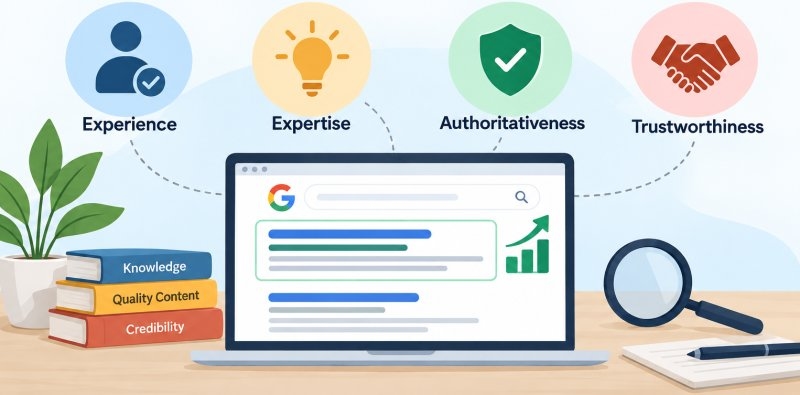
You've probably seen the term E-E-A-T thrown around in SEO circles, maybe in a Slack channel, a client call, or one of those "what changed in the latest Google update" posts. It stands for Experience, Expertise, Authoritativeness, and Trustworthiness, and honestly, once you get past the acronym, the idea is pretty commonsense. Google wants to put trustworthy, well-informed content in front of people, not thin filler written by someone who's never touched the topic. If you're writing or managing content for a living, this isn't something to skim past. It affects real rankings.
Key Takeaways:
- E-E-A-T is short for Experience, Expertise, Authoritativeness, and Trustworthiness, the four things Google checks for when sizing up content quality.
- It's not a direct ranking factor on its own, but it quietly shapes a lot of the signals that are.
- Trust seems to matter most of the four. If a site feels untrustworthy, the rest barely counts.
- YMYL topics like health, money, and safety are judged much more harshly than a casual blog post about hobbies.
- Real experience, solid expertise, and a little industry recognition – none of it happens overnight, but it does add up.
What is E-E-A-T?
E-E-A-T comes out of Google's Search Quality Rater Guidelines, basically a manual that real people use to score search results by hand. Those scores don't directly bump your rankings up or down, but they train the algorithms that eventually do.
It actually started as just E-A-T back in 2014. Google tacked on the second "E" for Experience in December 2022, and honestly, it made sense. Someone who's actually lived through something usually writes about it better than someone who just read a few articles and summarized them. A camping gear review from someone who's spent thirty nights outdoors just hits different than one written from a spec sheet.
These days E-E-A-T isn't limited to the classic blue links either. It shapes what shows up in AI Overviews and AI Mode too, so if anything, it matters more now than it used to.
Why Does E-E-A-T Matter for SEO?
At the end of the day, Google doesn't want to send people to unreliable sources. That's really the whole point of this framework.
- Content with strong E-E-A-T signals tends to hold its ranking better and keeps people reading longer.
- Sites that skip this, especially in health and finance, have taken real hits during past core updates. Some never fully recovered.
- The Helpful Content System got folded into Google's main ranking algorithm back in 2024, which only cranked up how much this stuff matters.
So skipping it isn't really an option if you want your content to last. It's essential to create evidence-backed content in order to be visible.
How Does Experience in SEO Improve Content Quality?
This is really about showing your work. Experience in SEO means proving you've actually been through what you're writing about, not just paraphrasing someone else's take on it.
A few things that help here:
- Sharing real stories, including the parts that went wrong, not just the highlight reel.
- Using your own photos or videos instead of grabbing stock images.
- Writing an author bio that actually explains your connection to the topic, not just a generic "content writer" tag.
Someone who bought the product, used it for a few weeks, and posted their own unboxing photos will almost always read as more credible than a roundup stitched together from ten other roundups.
What are expertise signals Google looks for?
Expertise is a bit different from experience. It's less "I've lived this" and more "I actually understand this at a deep level." Some things that tend to show it:
- A bio that spells out real credentials or relevant professional background.
- Content that goes beyond the obvious and answers the trickier follow-up questions people actually have.
- Links to credible research or established sources backing up any claims made.
- Related content is grouped together, so it's clear a site covers the topic seriously, not just once and never again.
One thing worth flagging: for YMYL content like medical or financial advice, actual credentials matter a lot. Enthusiasm alone doesn't cut it when someone's health or money is on the line.
What is authoritativeness in the context of SEO?
Authoritativeness is basically your reputation, except you don't get to declare it yourself. Other sites and other people have to vouch for you, which is what makes it tricky to fake.
Some ways it gets built over time:
- Earning backlinks and mentions from sites people already trust.
- Publishing original data or research that other sites end up referencing.
- Getting featured on podcasts, in interviews, or in press write-ups.
- Collecting honest reviews from actual customers, not planted ones.
Also worth remembering, authority doesn't carry over between unrelated topics. A finance site with a great reputation for investing content isn't suddenly authoritative the moment it publishes a skincare post.
Why is Trustworthiness the Most Important Pillar?
Of the four, trust probably does the most work. You could have plenty of experience and solid expertise, but if the site itself feels sketchy, none of that really matters.
Some basics that go further than people expect:
- A clear "About" page and real, findable contact information.
- HTTPS across the entire site, not just the homepage.
- Honest disclosure whenever content is sponsored or has affiliate links.
- Regular fact-checking and updates so nothing sits around going stale.
Take trust away, and the other three pillars sort of fall apart on their own. That's probably why Google relies on it so heavily as the foundation for the whole framework.
How Does Google Search Quality Rely on E-E-A-T?
Google's quality raters manually go through search results and score them against these guidelines. That score doesn't flip your ranking overnight, but it feeds into the training data that shapes the algorithm in the long term.
Former Google Search Liaison Danny Sullivan once said something worth remembering here: E-E-A-T isn't a clean technical signal the way page speed is, but Google still uses a bunch of proxy signals to approximate how a human would judge it. So yes, it's indirect. But it's also very real, whether or not anyone can point to a single line of code that does it.
How Can You Improve E-E-A-T on Your Website?
There's no magic fix here, and if someone's selling you an overnight E-E-A-T hack, that's a red flag on its own. Still, a few things reliably help:
- Give writers real bios linked to actual professional profiles; skip the vague "staff writer" credit.
- Go back and refresh old, thin pages instead of letting them rot.
- Build backlinks the honest way, through research, outreach, and genuine PR.
- Mention certifications, press mentions, or awards where they're actually relevant.
- Cut back on intrusive ads or anything that makes a page feel off to visit.
None of this happens fast. It's more of a slow grind that pays off the longer you keep at it.
Final Thoughts
E-E-A-T isn't something you check off once and move on from. It's more like a habit, one built around making genuinely useful content and being upfront about why anyone should believe it. Weave experience, expertise, authoritativeness, and trustworthiness into how you actually create content, not just as an afterthought, and you're not only chasing rankings anymore. You're building something people keep coming back to.
FAQs
1. What does E-E-A-T stand for in SEO?
E-E-A-T stands for Experience, Expertise, Authoritativeness, and Trustworthiness. Google’s quality raters use this as a kind of litmus test to determine how credible and helpful the content is before it shapes rankings.
2. Is E-E-A-T a direct Google ranking factor?
Not exactly. Google doesn’t treat it as a simple switch. Instead, it uses a bunch of proxy signals to estimate those qualities, and those signals then quietly (but consistently) affect how a page tends to perform in search over time.
3. What are YMYL topics, and why do they matter?
YMYL stands for “Your Money or Your Life” and covers topics like health, finance, and safety. In these areas, the E-E-A-T checks get stricter, since wrong advice could genuinely hurt someone.
4. How can small websites build authoritativeness?
Small websites can grow authoritativeness by getting solid backlinks, publishing original research, earning real media mentions, and staying steady with a well-defined topic scope.